Most Retirement Plans Have the Same Three Problems
Over the years, I’ve met with countless people in or approaching retirement, and I’ve seen the full spectrum of preparedness.
That said, the people who walk through my door aren't careless, and they’re not financially unsophisticated. Most of them have saved diligently for decades, worked with advisors, and thought seriously about their future. Some of these folks have kept their own spreadsheets and have binders. A few have their own back-of-the-napkin projections that they’ve run out to age 95.
And yet, almost every DIY retirement plan that I’ve reviewed has the same gaps. The same ones showing up again and again, in plans built by different people or their advisors in different cities for people in very different financial situations.
That tells me something..
These aren't just one-off mistakes. They stem from the way the financial industry has traditionally approached retirement planning and how most people think about money while they're busy accumulating it.
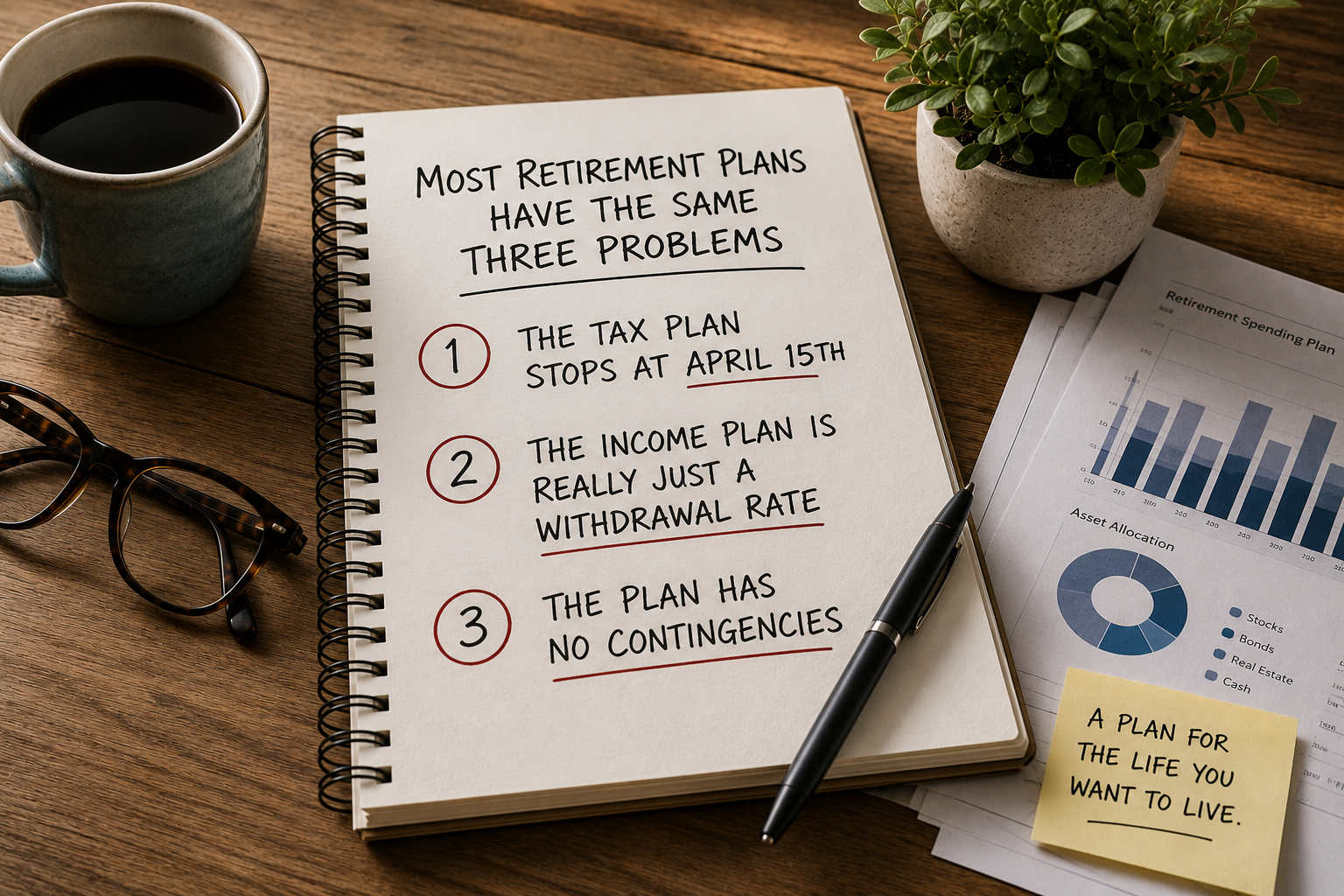
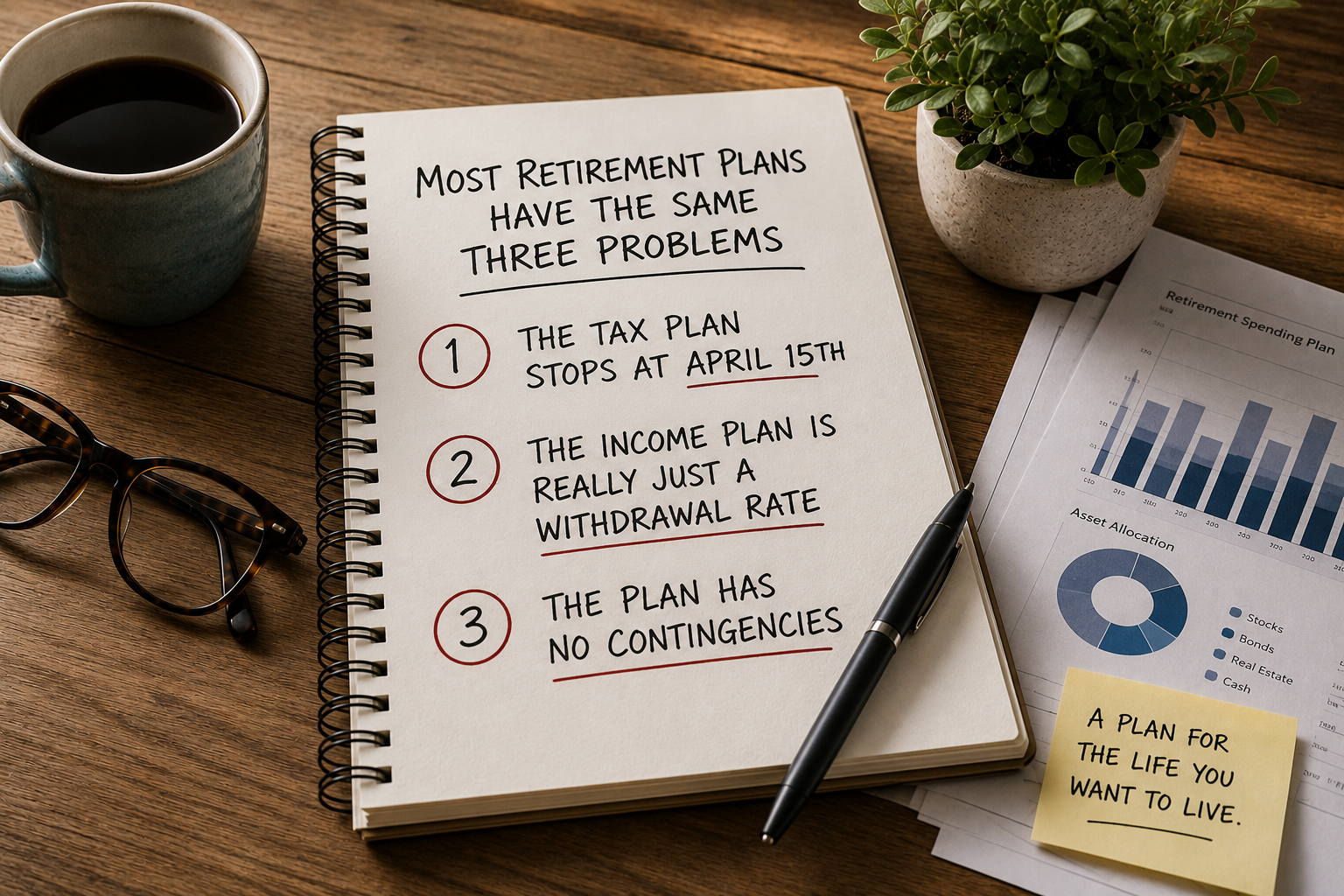
Here are the three holes I find in most retirement plans I review:
Hole #1: The Tax Plan Stops at April 15th
Most people have a tax preparer or CPA, yet way fewer have a well-defined lifetime tax plan. There's a meaningful difference between those two!
A tax preparer tends to look backward; they take what happened last year and file it accurately. Don’t get me wrong, that's valuable, but it's not planning.
Planning is about looking ahead. Instead of asking, "How can we save taxes this year?" it asks, "What's the smartest way to structure income, withdrawals, Roth conversions, and legacy decisions over the course of retirement to reduce taxes over time?"
The gap shows up most clearly in two places. The first is Roth conversions.
Between retirement and the start of Social Security (or between retirement and the onset of RMDs), many retirees sit in an unusually low tax bracket. For some, it's the lowest bracket they'll be in for the rest of their lives. That window is an opportunity to convert traditional IRA money to Roth at a lower rate than they'll ever pay again. Once RMDs kick in, once Social Security is fully in payment, once the income floor is set, that window greatly shrinks. Most retirement plans I review either ignore it entirely or treat it as an afterthought rather than a deliberate multi-year strategy.
The second is the RMD time bomb. A retiree with $1.2 million in a traditional IRA at age 65 will be required to start withdrawing from that account at 73 — whether they need the money or not. By then, that account may have grown to $1.8 million or more. The required distributions come out as ordinary income, stacking on top of Social Security, potentially pushing more of that Social Security into taxable territory, potentially triggering Medicare IRMAA surcharges, and potentially pushing the estate into Washington's estate tax threshold. None of this is inevitable. Almost all of it is plannable — but only if someone is actually looking ahead.
The fix isn't rocket science. It's a multi-year tax projection that maps out income, brackets, conversion opportunities, and withdrawal sequencing across the full retirement timeline. Most plans don't have one. Most tax preparers aren't building one. And most investment advisors (whose job is the portfolio, not the tax picture) aren't either.
This gap can cost lots of people lots of money. Quietly, invisibly, year after year.
Hole #2: The Income Plan Is Really Just a Withdrawal Rate
Ask most retirees how they plan to pay themselves in retirement, and you'll get some version of the same answer: "I'll take 4% a year from my portfolio, I heard that I should do that in some article."
Like any rule of thumb, a grain of salt is needed, and it’s certainly not an “income plan”.
A real income plan answers specific questions.
Which accounts do you draw from first, and in what order, and why?
How does that sequence change based on your tax bracket in a given year?
What happens to your withdrawal strategy if the market drops 30% in year two of retirement?
How does Social Security fit into the income structure, not just when you claim it, but how it interacts with your portfolio withdrawals every month?
What's the plan for the gap years between retirement and Medicare eligibility? Between retirement and Social Security? Between one spouse's retirement and the other's?
The 4% rule was never designed to answer any of those questions. It was a research finding about historical portfolio survival rates, certainly useful context, but not specific to your situation and monthly cash flow strategy.
What I see in most plans is a portfolio with an assumed withdrawal rate and not much else.
No account sequencing strategy. No tax-location awareness. No mechanism for adjusting spending dynamically when markets fall. No clear answer to "where does my paycheck actually come from on the first of the month?"
The practical consequence is that retirees end up making withdrawal decisions ad hoc, pulling from whatever account is most convenient, or whatever their advisor suggests in the moment, without a coordinated strategy behind it. Over a 25-year retirement, that improvisation has a cost. Studies consistently show that tax-efficient withdrawal sequencing alone can add years to a portfolio's longevity. Most plans leave that on the table.
The fix is a dynamic income plan that specifies the source, sequence, and tax treatment of every dollar coming in, with a clear decision framework for what changes when circumstances do.
Hole #3: The Plan Has No Contingencies
This is the one that bothers me the most, because it's the one with the highest stakes.
A retirement plan is a projection of the future. The future, reliably, does not cooperate. And yet almost every plan I review is built around a single scenario: the one where things go roughly as expected.
The market returns something close to its historical average. Both spouses stay reasonably healthy through their late 70s. Spending is relatively predictable. Nobody needs significant long-term care before 85. The kids are fine. The house doesn't need a new roof and a foundation repair in the same year. Nobody gets divorced.
What happens when something on that list goes wrong?
Most plans don't say. Not because the advisors who built them were negligent, but because contingency planning is hard, uncomfortable, and not what most clients ask for when they sit down to talk about retirement. People want to know if they're okay. They don't want to spend an hour talking about what happens if they're not.
But here's the thing: the scenarios that derail retirements aren't rare. They're common. More than half of retirees experience a significant unplanned financial event in the first decade of retirement — a health crisis, a family member who needs financial support, a market drawdown that arrives at the worst possible moment, a forced early retirement they didn't see coming. The plan that works beautifully in the baseline scenario and has no answer for any of those events isn't complete. It's a best-case scenario with a cover page.
The contingencies I look for specifically:
Early retirement:
What does the plan look like if you stop working at 62 instead of 66? More than half of retirees leave the workforce earlier than planned — due to health, layoffs, or caregiving demands. If your plan only works if you work until your target date, that's a risk worth naming.
A long-term care event:
At current costs, a memory care facility in the Pacific Northwest runs $8,000 to $12,000 a month. How long does the plan survive if one spouse needs that level of care for three years? Five years? What's the funding mechanism: insurance, self-insurance, home equity, or Medicaid planning? Most plans have no answer.
A significant market decline in the first five years of retirement:
Sequence of returns risk is well-documented and widely understood in theory. In practice, most plans don't have a written protocol for what changes (spending, withdrawals, Roth conversions) if the portfolio drops 35% in year two of retirement. "We'll adjust" is not a plan.
The premature death of the higher-earning spouse:
Social Security drops. The tax filing status shifts from married jointly to single. The surviving spouse may be managing finances alone for the first time. The estate plan kicks in. Is the surviving spouse's financial picture actually modeled out? In most plans I review, it isn't, or it's a footnote rather than a full scenario.
The fix is building at least two or three explicit contingency scenarios into every retirement plan, not to dwell on worst cases, but to confirm that the plan has a response to them. A retirement that can survive a punch is a fundamentally different animal than one that can only survive calm seas.
What Should You Do With This?
If you have a retirement plan, whether it's a 70-page document from your advisor, from years ago a spreadsheet you've built yourself, or something in between, here are three honest questions worth asking:
Does my plan include a multi-year tax strategy, or does it just assume I'll pay whatever I owe each April?
If there's no Roth conversion analysis, no RMD projection, no withdrawal sequencing strategy tied to tax brackets, there's a gap worth closing.Does my plan specify where my income comes from each month, or does it just show a portfolio balance and an assumed withdrawal rate?
If you can't answer "which account does my mortgage payment come from in year six," the income plan needs more work.Does my plan have a written response to the two or three scenarios most likely to disrupt it?
If the only version of your retirement that works is the one where everything goes roughly as planned, that's worth addressing before life has a chance to address it for you.
None of this requires starting over. In most cases, these are additions to an existing plan (a tax projection layer, a written income strategy, a contingency framework), not a replacement for the work that's already been done.
But they're the difference between a plan that looks good on paper and one that actually holds up.
Have any questions about what you’ve read? Let’s talk about them!
Read My Other Work!