What is the Best Age to Retire?
So, you’ve started to wonder when it’s time to hang it up. Your siblings, friends, and neighbors are starting to retire, and it’s got you thinking about when you should do the same.
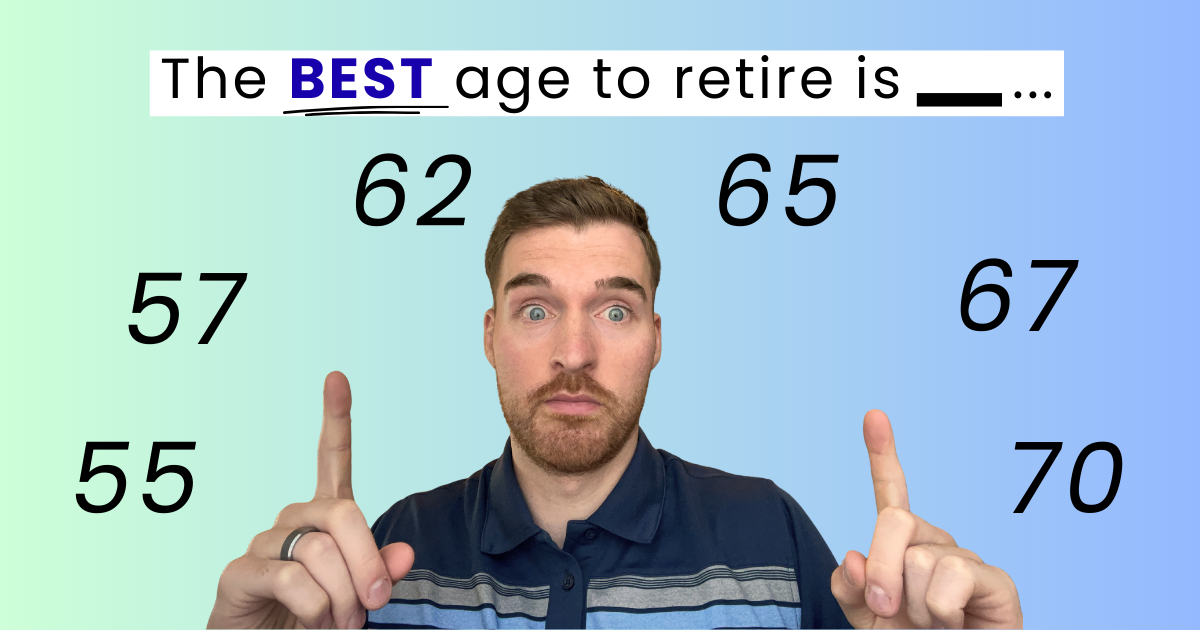
But inevitably, you ask the question:
“What’s the best age to retire?”
Most people are hoping for a straightforward answer. A specific age that’s foolproof and “optimal”.
But the reality is, of course, more nuanced.
The empirical data can tell us a lot about financial tradeoffs at different ages, but it can’t tell us how retirement will feel, how health will evolve, or how priorities will change. The best retirement decisions take into account both.
What the Data Suggests About Retirement Age
From a purely financial standpoint, retirement age matters because it affects three major variables at once:
1) How long you work.
2) When your retirement income sources begin.
3) How long your savings must last.
Most people in the U.S. retire somewhere between 62 and 67, largely because these ages align with key milestones.
Age 62 is the earliest you can claim Social Security. Claiming at this age permanently reduces your benefit, but it also allows you to stop working sooner and start drawing income earlier.
Between 66 and 67, most people reach full retirement age for Social Security. Benefits are no longer reduced, and income planning becomes more straightforward.
Delaying benefits until age 70 increases Social Security payments even further, which can be especially valuable for longevity protection and surviving spouses.
From a modeling standpoint, later retirement often looks more “efficient.”
-More years of earnings.
-More time for portfolios to grow.
-Higher guaranteed income.
However, this doesn’t tell the entire story. Typically, if we’re delaying retirement, we’re also deferring the very time and flexibility we’ve been working toward, often trading years of added income for years we can’t get back.
Why the “Optimal” Age Isn’t Always the Best One
Financial advisors often talk about an “optimal” retirement age, usually defined as the age that maximizes lifetime income and net worth or minimizes portfolio risk.
That framework is useful, but incomplete.
It assumes:
Equal utility in all retirement years
Stable health
Stable work satisfaction
And static life priorities
Real life doesn’t work that way.
Many people reach their early 60s with enough money but still hesitate to retire, not because they need to keep working, but because they’re unsure what retirement is supposed to look like.
Others push retirement later in the name of optimization, only to realize they postponed time they can’t get back.
The math and the numbers will always look “better” and be “larger” when delaying retirement, but it can mean giving up years when time, health, and enjoyment are most valuable.
There’s simply more that you can do and enjoy at 63 than at 73 or 83.
Retirement modeling software doesn’t have a good way of accounting for this.
How Different Retirement Ages Tend to Feel
Early 60s (around 60–62)
This stage often appeals to people who value time and health more than maximizing income. Retiring here typically requires careful planning around healthcare, taxes, and income sequencing, but it can offer flexibility while energy is still high.
Mid-60s (63–65)
This range is often a natural transition point. Work feels optional rather than mandatory. Medicare eligibility at 65 removes a major uncertainty. Many people feel mentally and physically ready for change without feeling rushed.
Late 60s (66–70)
Retiring later often reflects financial confidence and stability. Higher Social Security benefits and shorter retirement horizons reduce pressure on portfolios. The tradeoff is the risk of delaying life transitions too long in pursuit of optimization.
None of these ages are inherently better. They simply solve different problems.
The Emotional Side of Retirement Timing
One of the biggest blind spots in retirement planning is underestimating the emotional weight of the transition.
Retirement isn’t just about stopping work. It’s about replacing structure, identity, and routine. People who retire to something tend to adapt better than those who retire from something.
That’s why the best age to retire often has less to do with net worth and more to do with readiness, financially, psychologically, and socially.
A Better Question to Ask
Instead of asking, “What’s the best age to retire?”
A more useful question is:
“When can work become optional, and what do I want that option to give me?”
That reframing shifts the focus from precision to flexibility.
Good retirement planning doesn’t force a date.
It creates choice.
So, What Is the Best Age to Retire?
For most people, the best age to retire isn’t a single number.
It’s a window, a period where:
your finances can support your lifestyle,
your health allows you to enjoy the tradeoff, and
your sense of purpose extends beyond work alone.
Data helps define the boundaries of that window. Your values and priorities determine where you step through it.
The goal isn’t to retire as early or as late as possible; it’s to retire with intention and on terms that make sense for your life.
Have any questions about what you’ve read? Let’s talk about them!
Read My Other Work!