What $1.5 Million Gets You in Retirement in Southwest Washington
$1.5 million sounds like a lot of money.
And it is!
It represents decades of disciplined saving, foregone spending, and compounding patience.
For most people, it's the number they've been quietly working toward for thirty years, the number that, when they finally reach it, makes them think: “I think we're okay!”
But "I think we're okay" and "I know exactly what I have and where it comes from" are two very different places to stand at 65.
So let's answer the question directly, not with national averages or generic retirement calculators, but with a real case study built around a hypothetical Southwest Washington couple, Marty and Candice.
Note- Obvious disclaimer that this situation almost certainly isn't yours.
Marty and Candice are being used as an example to show how the pieces interact for a Washington retiree, not a blueprint to measure yourself against. Your accounts, your Social Security, your spending, and the retirement you actually want will look different.
Meet Marty and Candice
Marty is 67, and Candice is 65, and they live in Camas, WA.
Marty recently retired after a long career in engineering; Candice just left her position in healthcare administration.
They own their home outright, worth about $680,000. They hold a small debt on one of their cars that will be paid off soon.
Their retirement accounts, which are moderately invested in a combination of stock and bond funds, look like this:
Traditional IRA / 401(k): $1,100,000
Roth IRA: $150,000
Brokerage: $250,000
Total portfolio: $1,500,000
They’ve identified their guaranteed income sources as:
Marty’s Social Security: $3,000/month at age 67 (full retirement age)
Candice's Social Security: $2,000/month at age 67 (full retirement age)
Total guaranteed income: $5,000/month ($60,000/year)
Both of them are currently on Medicare after having retired and attaining age 65.
They both have a strong family history of longevity and want to plan for the possibility of living to age 100.
They have an adult child who is very successful and has been a good saver, so they don’t feel the need to leave much of an inheritance. They will plan to leave their home to their child.
This is a very common profile for the retirees I work with in Clark County: they’ve done a great job saving, they have several different types of accounts and income sources, and now they’re trying to figure out how all the pieces should work together.
On the surface, $1.5 million is a strong retirement portfolio!
But the more important question is what that money can actually support, and how they should draw from it in a way that is sustainable, tax-efficient, and aligned with the retirement they want to live.
Using “Retirement Guardrails” to Assess Spending Capacity
The first question most people ask is: “How much can we actually spend every month?”
As it turns out, the answer is more complicated than applying a simple rule of thumb like the 4% rule, which suggests starting retirement by withdrawing roughly 4% of your portfolio in the first year and then adjusting that amount for inflation over time. While that can be a useful starting point, it doesn’t account for the many variables that can shape a retiree’s actual spending capacity.
A better approach is to use what are often called “retirement guardrails.”
At first, that may sound restrictive, like you’re being told to stay between the lines. In reality, guardrails are designed to give retirees a clear and flexible spending framework.
Rather than picking one withdrawal amount and hoping it continues to work for the next 30 years, guardrails help define how much you can sustainably spend today, when your financial picture may support an increase in spending, and when it may be prudent to temporarily pull back to keep the plan on track. The goal is to give retirees more confidence to enjoy their money when circumstances allow, while still making adjustments when markets, inflation, taxes, or other parts of the retirement plan change.
So, How Much Can They Sustainably Spend?
This is the question the guardrails framework is designed to answer, and it requires looking at Marty and Candice's full picture, their guaranteed income, their portfolio, and their risk tolerance, combined into a single spending number they can actually live by.
The target we're calibrating to is an 80% chance of underspending by the end of their planning horizon, meaning in most market environments, they end up with money remaining.
The other 20% represents scenarios where they would have overspent relative to what the portfolio could support, not a catastrophe, but a signal that we would have needed to adjust something small along the way.
That gives us our “retirement paycheck,” and from there, we create two retirement guardrails.
The upper guardrail:
If the portfolio grows beyond expectations, their spending can increase; they've earned a “raise”, and the plan can support it while staying on track.
The lower guardrail:
If markets underperform, spending adjusts modestly downward- a pre-agreed course correction to keep the plan on solid footing.
The result is a retirement income strategy that breathes with real life rather than assuming the world cooperates perfectly for 30 years.
Here's what that looks like for Marty and Candice:
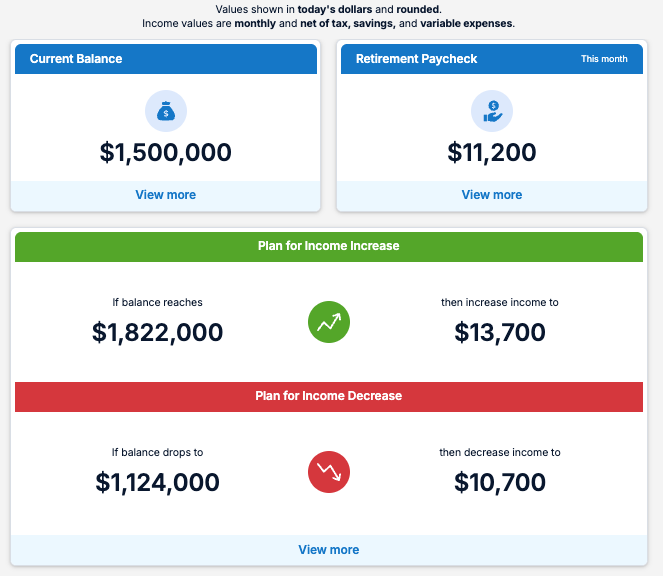
You’ll notice that these spending numbers are presented in today’s dollars and on a “net” basis, meaning after appropriate tax withholdings have been accounted for.
They also assume that throughout retirement, Marty and Candice’s spending patterns behave like typical retirees by following the “retirement spending smile”.
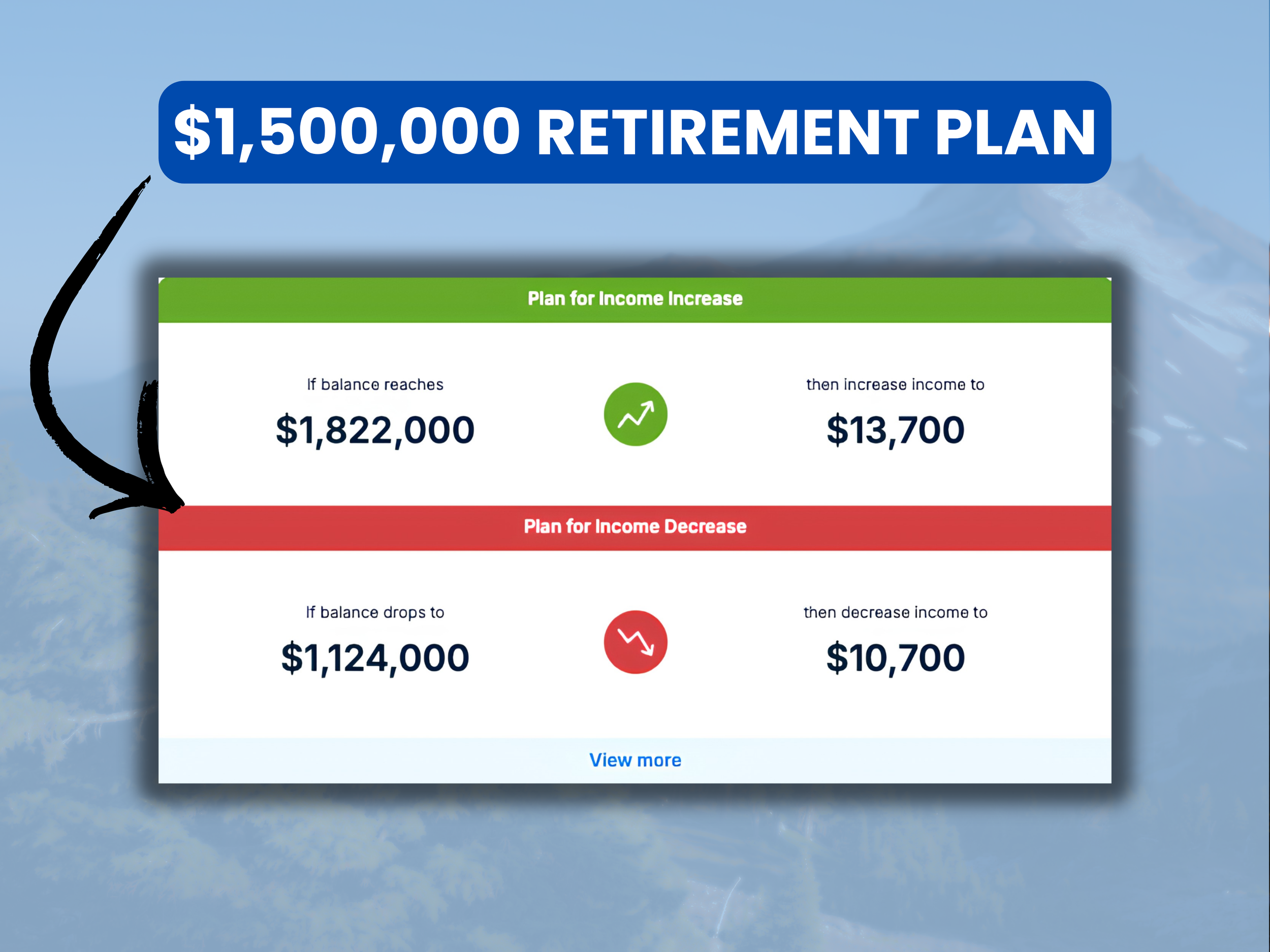
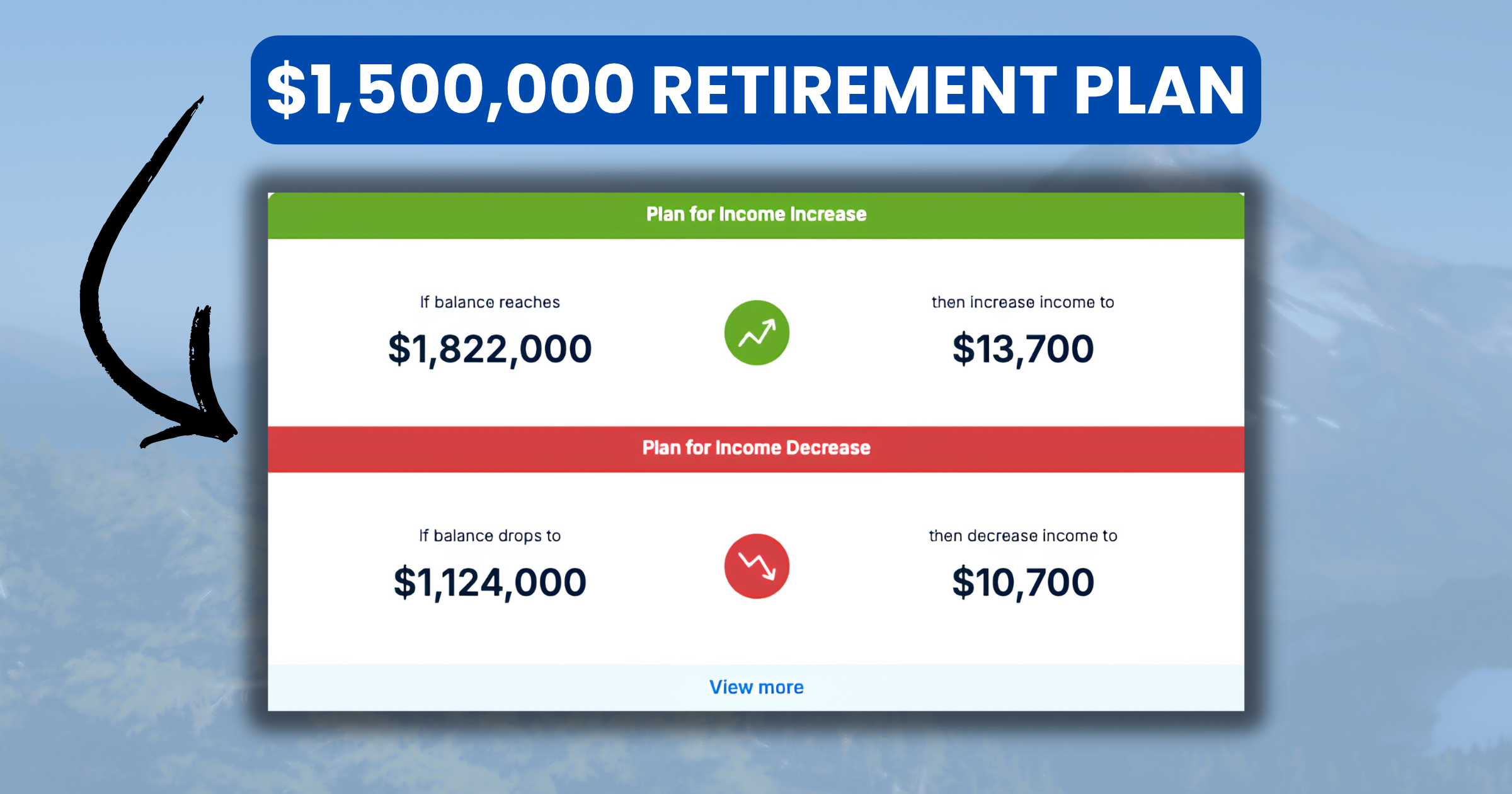
You can see how this framework creates clear decision points. If strong market returns, an inheritance, or some other positive change pushes their portfolio above roughly $1.82 million, they could increase their spending by about $2,500 per month.
On the other hand, if a market downturn causes the portfolio to fall to roughly $1.12 million, the adjustment is relatively modest: reducing spending by about $500 per month until the plan recovers.
That flexibility helps keep the retirement plan on track without forcing dramatic lifestyle changes every time the market moves.
The Account Sequencing Question
With $1.1 million sitting in a traditional IRA, Marty and Candice have a tax issue worth understanding, though it may not fully surface for another decade or more.
At 73, Marty will be required to start taking Required Minimum Distributions from that IRA whether he needs the money or not. His first RMD at that point may fit reasonably well within their normal spending, not a major disruption. The real issue tends to develop later.
As Marty moves into his 80s, the IRS life expectancy factor used to calculate RMDs continues to shrink, meaning a larger percentage of the account must be distributed each year. Even if the account hasn't grown dramatically, the forced withdrawal could be well north of $100,000 annually by then, stacking on top of Social Security, potentially pushing them into a higher bracket, and triggering Medicare IRMAA surcharges they weren't budgeting for.
The window between now and when that becomes a real issue is a planning opportunity most couples in Marty and Candice's position don't fully use.
The Roth conversion opportunity:
In years when their income is lower, perhaps before both Social Security benefits are fully optimized, or in a year with lower portfolio withdrawals, converting a portion of the traditional IRA to Roth at their current bracket (likely 22%) could save significant taxes compared to being forced to withdraw at potentially 24% or higher later, with IRMAA stacking on top.The withdrawal sequencing strategy:
In the near term, drawing from the taxable brokerage account first (where long-term capital gains rates may be 0% or 15%) while letting the IRA compound can create meaningful tax efficiency. The Roth gets touched last, giving it the longest runway to grow tax-free and providing the most flexibility in later retirement.
This sequencing isn't automatic. It requires intentional year-by-year planning, which is exactly the kind of thing that falls through the cracks in most advisory relationships.
The SW Washington-Specific Factors
A few things about this market that change the numbers in ways a national calculator never captures:
The Oregon border:
Marty and Candice make large purchases across the river in Oregon where there's no sales tax. On a $4,000 couch purchase, that's $348 in sales tax they don't pay. It's not a strategy most financial plans mention. It's one that Clark County residents have quietly practiced for decades.
Property taxes and the senior exemption:
At their income level, Marty and Candice don't currently qualify for Clark County's senior property tax exemption. But as they age and their income picture changes, particularly if one spouse predeceases the other and income drops, that exemption is worth revisiting annually. A meaningful reduction in assessed value can save hundreds to thousands per year.
Washington's estate tax:
Marty and Candice's combined estate ($1.5 million portfolio plus $680,000 home) is $2.18 million today. Washington's estate tax exemption is $3,076,000 per individual, with no portability between spouses. If Marty dies first and leaves everything to Candice, her combined estate approaches the exemption threshold, and if it grows or if life insurance is added to the picture, it crosses it. This is a planning conversation worth having now, not after the first death.
Healthcare costs:
Both on Medicare, but Medicare isn't free. Combined premiums for Parts B and D, plus a supplement or Advantage plan, plus dental, vision and out-of-pocket costs, a reasonable budget for Marty and Candice is $8,000 to $12,000 per year combined. That's a line item that needs to be in the spending plan, not treated as a surprise.
The Things That Could Change This Picture
The numbers above assume:
The portfolio earns roughly its historical average over a 25-30 year period.
Spending stays relatively predictable.
Neither Marty nor Candice needs significant long-term care before their mid-80s.
No major unplanned expenses hit in the first five years of retirement.
Remove any one of those assumptions and the picture shifts. A 30% market decline in year two. A memory care event at 74. An adult child who needs significant financial support. A home that needs a new roof, HVAC, and foundation work in the same two-year window.
This is why the guardrails framework matters more than the initial withdrawal rate.
And why a plan built for the average scenario, without contingencies, without tax strategy, without a written income structure, is a plan that works until it doesn't.
The Recap
$1.5 million in Southwest Washington gets you a real, sustainable, comfortable retirement, if it's planned well.
It does not get you financial invincibility. It does not make the tax decisions irrelevant, the account sequencing unimportant, or the estate planning optional. In fact, at $1.5 million, the planning arguably matters more than it does at $500,000, because there's enough complexity to do real damage if it's handled carelessly, and enough opportunity to add real value if it's handled well.
The couples who feel most confident at this level aren't the ones with the best investment returns. They're the ones who know exactly where their income comes from each month, have a plan for what changes if the market drops, have thought through the tax picture five years ahead, and aren't lying awake doing math in their heads at 3am.
That's what $1.5 million plus a real retirement plan gets you in Southwest Washington.
Have any questions about what you’ve read? Let’s talk about them!
Read My Other Work!